Fractal Guide
What is the Julia Set?
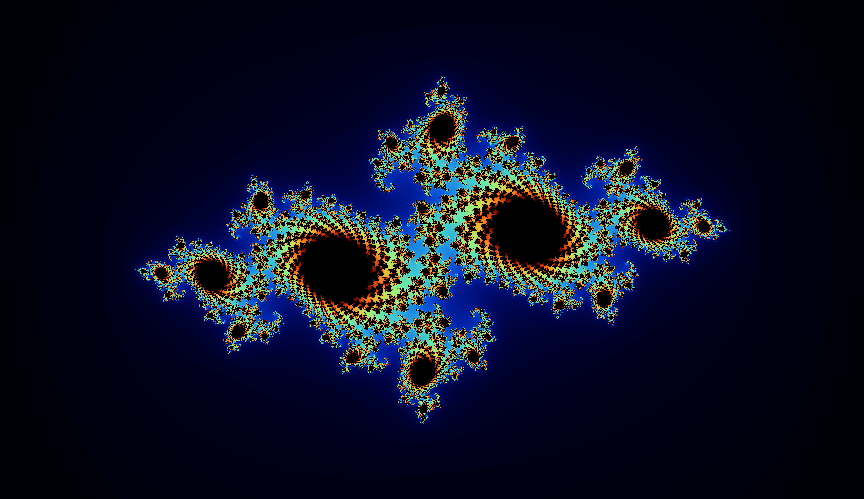
The Julia set is one of the most beautiful and varied sets in fractal geometry. A slight change in parameters reveals entirely different worlds.
Contents
1. Definition of the Julia Set
The Julia set is defined by the recurrence z(n+1) = z(n)² + c, where c is a fixed parameter. For each point z₀ on the complex plane used as the initial value, the Julia set consists of all z₀ for which the sequence does not diverge.
Intuitively, it's the collection of starting points where repeatedly applying this formula doesn't send the result flying off to infinity. Coloring points by how fast they diverge creates the stunning fractal images we know.
The Julia set has a different shape for each value of c. For some values of c, the set is 'connected' (a single piece), while for others it fragments into countless scattered points (Cantor dust).
2. History and Discovery
The Julia set originates from a paper published in 1918 by French mathematician Gaston Julia (1893–1978). Without computers, Julia himself could never see the visual beauty of these sets.
In the late 1970s, Benoît Mandelbrot used computers to render Julia sets, revealing their astonishing fractal structures to the world. Julia's theoretical work was finally visualized through computer graphics some 60 years later.
3. Relationship with the Mandelbrot Set
The Mandelbrot set and Julia sets are deeply connected. The Mandelbrot set is the set of c values for which the sequence starting from z₀ = 0 does not diverge. The Julia set, in contrast, fixes c and varies z₀.
A key property: choosing c inside the Mandelbrot set yields a connected Julia set, while choosing c outside gives a Cantor dust Julia set. The Mandelbrot set can thus be seen as a 'catalog of all Julia sets.'
4. Parameters and Shape Variations
A slight change in c drastically alters the Julia set's shape. Here are some notable parameter examples.
c = -0.7269 + 0.1889i: A delicate dendritic pattern. Choosing c near the boundary of the Mandelbrot set produces such complex shapes.
c = 0.285 + 0.01i: An endlessly spiraling pattern that beautifully demonstrates fractal self-similarity.
c = -0.123 + 0.745i: The famous 'Douady's Rabbit' shape, characterized by three branches that recursively subdivide.
5. How Rendering Works
Julia set rendering uses the escape time algorithm. For each pixel on the complex plane, the recurrence z(n+1) = z(n)² + c is iterated, checking whether |z| exceeds a threshold (usually 2).
Divergent points are colored by their iteration count, while non-divergent points (reaching max iterations) are colored black. This algorithm is well-suited for parallel computation, and Tool Palette uses Web Workers for fast rendering.
Increasing the maximum iteration count reveals finer detail near boundaries, but also increases computation time. Choosing appropriate iteration counts for the zoom level is important.
Explore the Julia Set
Interactively explore the Julia set in the Fractal Gallery.
Go to Fractal Gallery